
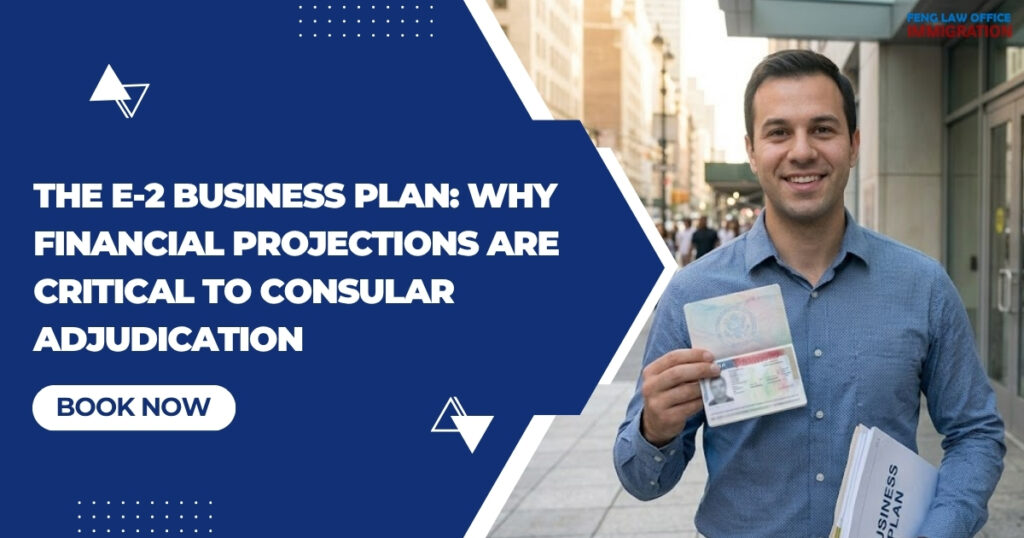
For many international entrepreneurs, the E-2 Treaty Investor visa provides a viable pathway to establish and operate a business in the United States. It permits qualified investors from treaty countries to direct and develop an enterprise while residing in the U.S. for the duration of the investment activity.
However, approval is not based solely on the amount of capital invested or the applicant’s intent. At Feng Law Office ׀ Immigration, we often tell our clients that a well-documented and credible business plan—supported by rigorous financial projections—is central to demonstrating eligibility under applicable statutory and regulatory standards.
At a practical level, the business plan serves as the primary evidentiary framework through which a consular officer evaluates whether the enterprise satisfies core E-2 requirements, including substantial investment, non-marginality, and operational viability.
The “Substantial Investment” Requirement and the Proportionality Test
The E-2 classification does not impose a fixed minimum investment amount. Instead, adjudicators apply the proportionality test, which assesses whether the invested capital is substantial relative to:
- The total cost of purchasing an existing business; or
- The cost of establishing a new enterprise
In current adjudication practice, emphasis is placed not only on the amount invested but on whether the funds are “irrevocably committed” and “at risk” for the purpose of generating a return.
Qualifying evidence may include:
- Executed lease agreements
- Equipment and inventory purchases
- Paid invoices and contracts
- Escrow arrangements contingent upon visa approval
- Bank records documenting the transfer and expenditure of funds
Funds that remain idle in a personal or corporate account, without clear commitment to the enterprise, are generally insufficient to satisfy this requirement.
The Non-Marginality Requirement
A central element of E-2 eligibility is that the enterprise must not be marginal. Under applicable regulations, a marginal enterprise is one that does not have the present or future capacity to generate more than sufficient income to provide a minimal living for the investor and their family.
To meet this standard, the applicant must demonstrate that the business:
- Has the capacity to generate significant economic activity, or
- Will make a meaningful contribution to the U.S. economy within a reasonable timeframe
A properly developed business plan, including five-year financial projections, is critical to this analysis. These projections should reflect:
- Revenue growth based on reasonable market assumptions
- Scalable operations
- A trajectory toward profitability that exceeds subsistence-level income
Applications are frequently refused where projections indicate that the business will merely sustain the investor without broader economic impact.
Core Financial Components of a Credible E-2 Business Plan
To withstand consular scrutiny, the financial section of an E-2 business plan should address three key components:
Job Creation and Economic Impact
While the E-2 visa does not impose a fixed job creation requirement, adjudicators expect to see a credible plan for hiring U.S. workers.
A persuasive business plan should include:
- A hiring timeline specifying when employees will be onboarded
- Defined roles and projected wages
- A transition plan from initial lean operations to a staffed enterprise
Even for service-based or early-stage businesses, demonstrating future job creation is a strong indicator of non-marginality.
Cash Flow and Break-Even Analysis
Consular officers closely examine whether the enterprise can achieve financial sustainability.
A robust plan should include:
- Detailed cash flow projections
- A clearly defined break-even point
- Reasonable expense assumptions consistent with industry standards
Overly optimistic or unsupported projections may undermine credibility. Financial modeling should be internally consistent and supported by verifiable data.
Market Analysis and Commercial Viability
A data-driven market analysis is essential to demonstrate that the business is viable within its intended U.S. market.
This section should address:
- Target customer base and demand indicators
- Competitive landscape
- Pricing strategy
- The business’s unique value proposition
Generic or unsupported market assertions are typically given limited evidentiary weight.
Common Deficiencies in E-2 Business Plans
Even otherwise qualified applicants may face refusal due to deficiencies in the business plan. Common issues include:
- Inconsistent financial data across different sections of the application
- Insufficient documentation showing how investment funds were expended
- Unrealistic projections not supported by market data
- Failure to demonstrate “at-risk” investment
- Inadequate explanation of the business model or revenue streams
Given the discretionary nature of consular adjudication, credibility and coherence are critical.
Strategic Considerations
An E-2 application should be approached as a comprehensive evidentiary presentation, not merely a form submission. The business plan should:
- Align with all supporting documentation
- Present a clear and credible narrative
- Anticipate and address potential adjudicatory concerns
Professional preparation—particularly with respect to financial projections—can significantly reduce the likelihood of delays, requests for additional evidence, or refusal.
Conclusion
A well-prepared E-2 business plan is not a formality; it is central to demonstrating eligibility under the treaty investor framework. Financial projections, in particular, play a decisive role in establishing that the enterprise is both viable and non-marginal.
Applicants who present a coherent, evidence-based plan that aligns with regulatory requirements are substantially better positioned for approval.
FAQs
Generic templates may provide structural guidance but are generally insufficient. Consular officers expect a plan tailored to the specific business, industry, and geographic market.
Costs vary depending on complexity, but professionally prepared plans commonly range from approximately $2,500 to $5,000. Higher-quality financial modeling may increase the likelihood of approval.
While total investment is important, adjudicators often focus on job creation projections, profitability timelines, and whether the business will generate income beyond a minimal living.
Minor operational adjustments are generally permissible. However, a material change to the nature of the business may require a new application or further review. Legal counsel should be consulted before making significant changes.
Frequent issues include failure to demonstrate an at-risk investment, marginal business projections, inconsistent financial data, and lack of credible supporting documentation.
-
Facebook
-
Twitter
-
Pinterest
-
Linkedin
Trust us and call us today.

Zechen Feng
Zechen Feng is the founder and principal attorney at Feng Immigration Law, where he is dedicated to helping individuals and families navigate the U.S. immigration system with clarity and confidence. With extensive experience in immigration law and a personalized approach to every case, Zechen is passionate about advocating for his clients’ rights and futures. Through the blog, he shares practical guidance, legal updates, and expert insights to empower those on their immigration journey.


 ICONIER Digital Agency