
If you’re looking into green card sponsorship for a spouse, parent, or child, you’ll hear one phrase constantly: immediate relative. This category can make the process feel “faster” because it’s treated differently than family sponsored preferences (the categories that often come with long visa backlogs).
Below is a practical guide to define immediate relative, explain who can sponsor an immigrant, and show the real-life steps for immigration sponsorship from I-130 to a green card.
What is immediate relative in U.S. immigration?
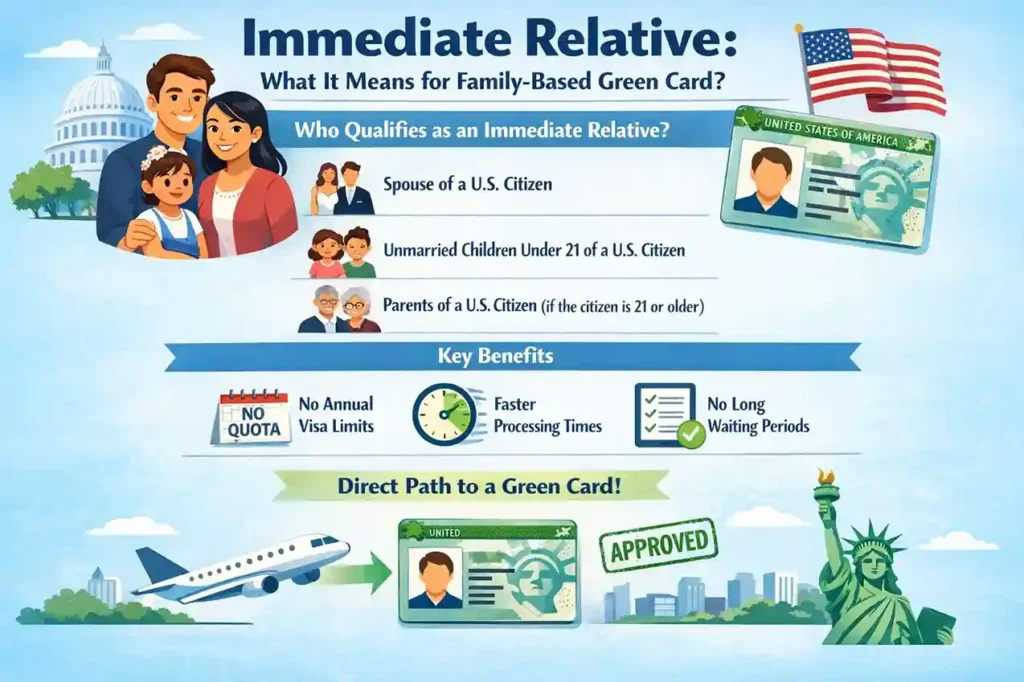
In U.S. immigration law, immediate relatives are a specific group of close family members of U.S. citizens. USCIS describes the group as: spouse, unmarried child under 21, or parent of a U.S. citizen (and the U.S. citizen must be at least 21 to petition for a parent).
Why it matters: the U.S. Department of State notes that Immediate Relative immigrant visas are not limited each fiscal year, unlike preference categories.
Who qualifies as an immediate relative?
USCIS’s “immediate relative” green card category generally includes:
- Spouse of a U.S. citizen
- Unmarried child under 21 of a U.S. citizen
- Parent of a U.S. citizen (petitioner must be 21+)
Child has a specific meaning: USCIS uses specific definitions for “child,” “son,” and “daughter,” and age/marital status can change which category applies. This matters a lot for timing and eligibility.
Immediate relative’s vs family preference visa categories
This is the key comparison that affects wait times.
Immediate family immigration (U.S. citizens)
If the beneficiary fits the immediate relative definition, the case isn’t competing for a limited number of visas each year (though USCIS processing still takes time).
Family preference visa (U.S. citizens + green card holders)
If the relative is not an immediate relative, they usually fall into family sponsored preferences (also called “Family Preference”) and may have to wait for visa availability.
USCIS lists these preference categories, including F2A visa for spouses and unmarried children (under 21) of lawful permanent residents.
Simple takeaway:
- U.S. citizen + spouse/parent/minor child → likely Immediate Relative Lane
- Green card holder + spouse/minor child → often F2A (preference lane)
- Sibling of a U.S. citizen → preference lane (often the longest)
Who can sponsor an immigrant?
People usually ask this as: who can sponsor an immigrant and what is visa sponsorship?
For family-based cases, a U.S. citizen or lawful permanent resident can generally start the process by filing the petition for alien relative (Form I-130), if the relationship fits the rules. The exact filing strategy can differ depending on:
- where your relative is located (U.S. vs abroad),
- whether they’re eligible for adjustment of status, and
- whether they’re in a preference category with a waiting line.
How do I sponsor an immigrant? Step-by-step (the realistic version)
Here’s the cleanest “big picture” how do i sponsor an immigrant roadmap.
1) File Form I-130 (Petition for Alien Relative): USCIS says submitting Form I-130, Petition for Alien Relative is the first step to help an eligible relative immigrate and apply for permanent residence.
2) Wait for USCIS to process the petition: USCIS publishes a processing-times tool so you can check estimates by form, category, and office.
3) After approval: the case moves forward in one of two ways
- Consular processing (relative abroad): The Department of State explains that after petition approval, the case typically moves into the immigrant visa process (often through the National Visa Centre).
- Adjustment of status (relative in the U.S., if eligible): This is a different path and depends on the person’s situation.
4) Financial sponsorship (Form I-864)
For many family-based immigrant visas, the government requires an Affidavit of Support (Form I-864). The Department of State explains the petitioner must complete the I-864 and that the person who signs it is called the “sponsor.”
What is visa sponsorship in a family case?
In everyday language, what is visa sponsorship usually means two things:
- The petition: You file Form I-130 to prove the family relationship.
- The financial commitment: You sign Form I-864 to accept financial responsibility (and may need a joint sponsor if income isn’t enough).
Common mistakes that slow down immigration sponsorship
Even when someone qualifies as an immediate relative, delays happen—usually for preventable reasons:
- Filing the I-130 with incomplete or inconsistent documents
- Weak proof of relationship (especially for spouses)
- Missing required civil documents or translations during the NVC stage
- Forgetting the I-864 (or sending incomplete financial evidence), which the State Department warns can delay case processing
- Using unauthorized “consultants” (notaries) who aren’t allowed to give immigration legal advice
Quick safety check (worth 2 minutes)
USCIS has an “Avoid Scams” hub, and the FTC warns that many scams involve people pretending to be authorized providers.
If you’re sponsoring a relative, a little prep goes a long way:
- Build a clean “evidence folder” (IDs, birth/marriage records, prior divorce documents, etc.)
- Create a one-page relationship timeline (dates + places)
- Screenshot and save every USCIS receipt/notice
- Track your case using official tools (case status + processing times)
If anything is even slightly complicated (prior denials, tricky family situations, or uncertainty about category), a quick strategy review can prevent months—or years—of backtracking.
You can also read : USCIS Updates Guidance for EB-2 National Interest Waiver Petitions
Conclusion
Understanding immediate relatives is one of the fastest ways to set the right expectations for your family’s timeline. Once you know whether your case is Immediate Relative or family preference visa territory (like F2A), you can plan smarter—documents, fees, and next steps—without getting blindsided.
If you want help confirming the best category, building a strong I-130 packet, and avoiding costly delays, feng immigration law can guide you through the sponsorship process with a clear, step-by-step plan. Book a consultation or request a case review to get clarity before you file.
FAQs
It’s a specific category for a U.S. citizen’s spouse, unmarried child under 21, or parent (if the U.S. citizen is 21+).
Immediate Relative visas are not limited each fiscal year, so they’re treated differently than preference categories. You still have USCIS/NVC processing time, but you’re not typically waiting for a visa number the same way preference categories do.
Yes, but it’s commonly in the preference system (often F2A), not the Immediate Relative category.
USCIS says Form I-130 is the first step to help an eligible relative apply to immigrate and seek permanent residence.
I-130 proves the family relationship; I-864 is the Affidavit of Support where the sponsor accepts financial responsibility.
Use USCIS scam guidance and be cautious of notaries or consultants claiming they can provide immigration legal services when they’re not authorized.
Social Share
-
Facebook
-
Twitter
-
Pinterest
-
Linkedin
Trust us and call us today.

Zechen Feng
Zechen Feng is the founder and principal attorney at Feng Immigration Law, where he is dedicated to helping individuals and families navigate the U.S. immigration system with clarity and confidence. With extensive experience in immigration law and a personalized approach to every case, Zechen is passionate about advocating for his clients’ rights and futures. Through the blog, he shares practical guidance, legal updates, and expert insights to empower those on their immigration journey.


 ICONIER Digital Agency