
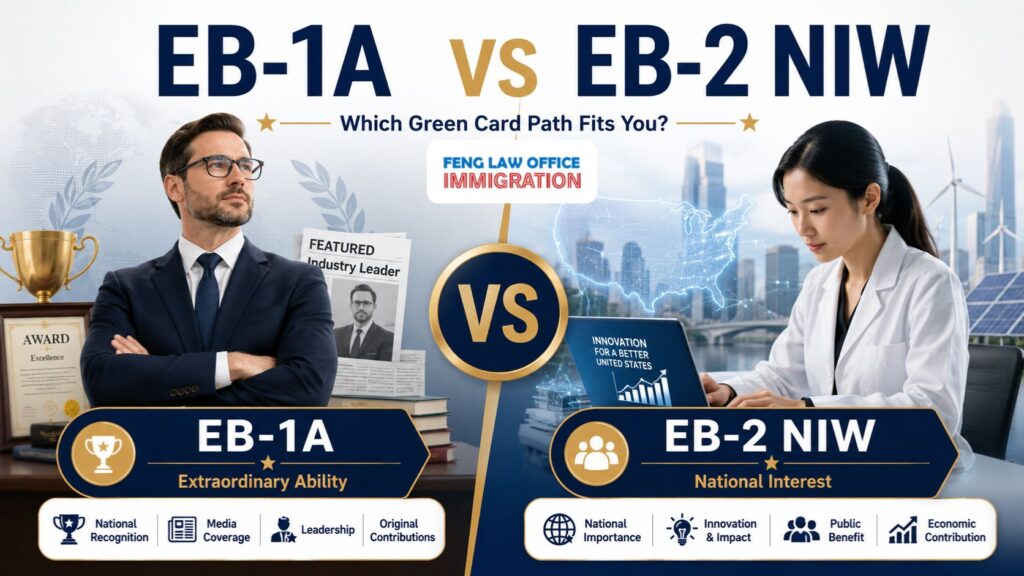
EB-1A vs. EB-2 NIW comes down to one hard question: what can you prove right now? EB-1A is usually better if you already have strong national or international recognition in your field. EB-2 NIW is often a better option if your work clearly benefits the United States, but your public recognition is still growing.
Both can be powerful self-petition green card options because neither requires a permanent employer sponsor in the usual sense. But they are not the same path with different names. One focuses more on your past achievements. The other focuses more on your proposed work and why the United States benefits from it.
EB-1A vs EB-2 NIW: the simple difference
EB-1A is for people who can show extraordinary ability in science, arts, education, business, or athletics. Federal regulations define extraordinary ability as a level of expertise showing the person is among the small percentage who have risen to the very top of the field. The petition usually needs either a major internationally recognized award or evidence meeting at least three listed criteria, followed by a full review of the case as a whole.
EB-2 NIW is different. First, you must qualify for EB-2 as either an advanced-degree professional or a person with exceptional ability. Then you must show that your proposed work has substantial merit and national importance, that you are well-positioned to advance it, and that waiving the job offer and labor certification requirements would benefit the United States.
In short: EB-1A asks, “Have you already reached the top of your field?” EB-2 NIW asks, “Is your work important to the U.S., and are you the right person to advance it?”
Quick comparison table: EB-1A green card vs EB-2 NIW green card
Factor | EB-1A green card | EB-2 NIW green card |
Main focus | Your record of achievement and recognition | Your proposed work and its national importance |
Core standard | Extraordinary ability | Advanced degree or exceptional ability plus national interest waiver |
Employer required? | No | No, if NIW is approved |
PERM labor certification? | No | Waived if NIW is approved |
Degree required? | No specific degree required | Usually, an advanced degree or exceptional ability |
Evidence style | Awards, media, judging, original contributions, high salary, major roles, publications | Proposed endeavor, national importance, qualifications, plan, letters, funding, impact evidence |
Typical fit | Highly recognized professionals, founders, researchers, artists, executives, and athletes | Researchers, entrepreneurs, engineers, doctors, policy specialists, business professionals, and public-interest professionals |
Risk | Higher evidence bar | National importance must be clearly argued |
Timing concern | Often stronger for backlogged applicants if eligible | Can still face EB-2 visa backlogs depending on the country |
In short: If your strongest story is “I am already widely recognized,” look hard at EB-1A. If your strongest story is “my work matters to the U.S., and I can advance it,” look hard at EB-2 NIW.
When EB-1A may be the better green card path
EB-1A may be the better path when your evidence shows you are not just skilled, but recognized as unusually accomplished in your field.
Strong EB-1A requirements evidence may include the following:
- Nationally or internationally recognized awards
- Published material about you and your work
- Judging the work of others
- Original contributions of major significance
- Scholarly articles or major professional publications
- Leading or critical roles for respected organizations
- High salary compared with others in your field
- Commercial success in the performing arts, where relevant
Here is the part many applicants get wrong: meeting three categories on paper does not automatically make a strong EB-1A green card case. USCIS looks at whether the full record shows sustained acclaim and a high level of recognition.
For example, a software founder with a funded company, major press coverage, patented technology, industry awards, and strong evidence that the product changed how others work may have a real EB-1A argument. A founder with only a company website, a pitch deck, and a few customer emails probably does not.
In short: EB-1A is not for “good professionals.” It is for people who can document a record that stands out sharply from others in the same field.
When EB-2 NIW may be the better green card path
EB-2 NIW may be better if your work has strong U.S. value, but your personal recognition has not yet reached the extraordinary ability visa level.
A strong EB-2 NIW green card case usually has three parts:
- A clear proposed endeavor
This means a specific area of work you plan to continue in the United States. - Proof that the endeavor has national importance
This could involve public health, AI safety, clean energy, infrastructure, education, cybersecurity, economic development, supply chain resilience, or another field with broader U.S. impact. - Proof that you are well-positioned
This may include education, work history, publications, patents, grants, contracts, business traction, letters from experts, or past success in related work.
The national interest waiver is not granted just because your job is useful. A local job that benefits one employer may not be enough. The case needs to explain why your work has broader value.
For example, a cancer researcher with peer-reviewed work, lab experience, clinical collaborations, and a clear plan tied to U.S. health outcomes may fit EB-2 NIW even without EB-1A-level fame. A cybersecurity professional working on systems that protect financial networks or critical infrastructure may also have a stronger NIW story than an EB-1A story.
In short: EB-2 NIW is not a consolation prize. It is often the smarter filing when your future work and national importance are stronger than your public acclaim.
Is EB-2 NIW easier than EB-1A?
Usually, yes, EB-2 NIW has a more flexible standard than EB-1A. But “easier” does not mean easy.
The mistake is thinking NIW only requires a good resume. It does not. The petition must connect your background to a proposed endeavor that matters beyond one company, one client, or one local market.
EB-1A is harder because it demands proof that you have risen to the top of your field. EB-2 NIW gives more room for professionals whose work is important but who are still building wider recognition.
That distinction matters for early-career researchers, entrepreneurs, AI professionals, engineers, physicians, and business specialists. Some may be too early for EB-1A but are very well positioned for EB-2 NIW requirements.
In short: EB-2 NIW is often more accessible, but weak national-importance arguments still fail.
Which is faster, EB-1A or EB-2 NIW?
The answer depends on two separate things: petition processing and visa availability.
Petition processing is about how long USCIS takes to review your I-140 petition. Visa availability is about whether a green card number is available based on your category and country of chargeability.
That second part is where many applicants get surprised. The U.S. Department of State Visa Bulletin controls when many employment-based applicants can move forward with immigrant visa issuance or adjustment of status. In July 2026, the Visa Bulletin showed EB-1 and EB-2 differences by country, including serious EB-2 limits for India.
So, EB-1A may be faster for some applicants, especially if EB-1 is moving better than EB-2 for their country. But if your EB-1A case is weak, a faster category does not help. A denied petition is not a shortcut.
Premium processing can speed up USCIS review of certain I-140 petitions, but it does not erase visa bulletin backlogs. That is a major point. Paying for faster petition review does not automatically mean faster green card approval.
In short: EB-1A may be faster if you qualify and visa numbers are better. EB-2 NIW may be smarter if your evidence fits NIW better, even if the category has timing issues.
Can you file EB-1A and EB-2 NIW at the same time?
Yes, some applicants file both EB-1A and EB-2 NIW petitions. This can make sense when the person has a genuinely strong profile for both categories.
But filing both is not always smart. It means more filing fees, more legal work, and two evidence strategies. If your EB-1A case is obviously premature, filing both may be a waste.
Dual filing may make sense when:
- You meet several EB-1A requirements with strong evidence
- Your proposed endeavor also fits EB-2 NIW requirements
- Your country of chargeability makes the priority date strategy important
- You can afford the added cost and document burden
- You understand that one approval does not guarantee the other
The safer approach is to complete an evidence audit first. Do not file two petitions just because you are nervous.
In short: Filing both can be useful for strong candidates. For weak or rushed cases, it can become expensive noise.
How to choose the better path: a practical evidence checklist
Use this simple framework before deciding.
Choose EB-1A if your evidence shows recognition
Ask yourself:
- Have independent experts recognized your work?
- Do you have awards, press, judging roles, or major contributions?
- Can you prove your work affected your field, not just your employer?
- Do you hold a leading or critical role in a respected organization?
- Would someone outside your company understand why your record is exceptional?
If most answers are yes, EB-1A may be worth serious review.
Choose EB-2 NIW if your evidence shows national value
Ask yourself:
- Can you clearly describe your proposed U.S. work?
- Does that work have scientific, business, health, cultural, educational, or economic value?
- Can you show impact beyond one employer or one small customer group?
- Do your credentials prove you are well-positioned?
- Can expert letters explain why your work matters to the United States?
If most answers are yes, EB-2 NIW may be the cleaner path.
Wait or strengthen your case if the evidence is thin
Sometimes the honest answer is not EB-1A or EB-2 NIW today. Sometimes the better move is to spend six to twelve months strengthening the record.
That may mean publishing more work, documenting product adoption, collecting stronger independent letters, building media coverage, taking on judging roles, clarifying a business plan, or gathering proof of industry demand.
In short: Do not choose based on ego. Choose based on evidence.
Common mistakes applicants make
The biggest mistake is forcing an EB-1A case because it sounds more prestigious. Prestige does not win the petition. Evidence does.
Another mistake is treating EB-2 NIW like a personal statement. The petition needs a serious national-interest argument, not just “I am talented and want to work in America.”
Applicants also weaken their cases by submitting too much weak evidence. More pages do not always mean a better petition. A clean, well-organized record often beats a messy file full of documents that do not prove the legal standard.
Other common mistakes include:
- Using recommendation letters that sound generic
- Failing to explain technical work in plain English
- Ignoring Visa Bulletin realities
- Confusing an O-1 approval with automatic EB-1A eligibility
- Assuming a high salary alone proves extraordinary ability
- Filing before the proposed endeavor is clear
In short: Immigration officers are not guessing what your evidence means. Your petition has to connect the dots.
FAQs
EB-1A is better if you can prove sustained national or international acclaim. EB-2 NIW is better if your work has national importance, but your recognition is still developing. The right answer depends on evidence, not preference.
Usually, EB-2 NIW is more flexible than EB-1A, but it still requires a strong proposed endeavor and proof that waiving the job offer and PERM process benefits the United States.
No, both can work as self-petition green card options. EB-1A does not require a job offer or labor certification. EB-2 NIW asks USCIS to waive the job offer and labor certification requirements based on national interest.
Yes, some applicants file both. It may make sense if your record supports both categories and timing matters. It is not smart if the EB-1A case is weak and is being filed only out of hope.
EB-1A can be faster for some applicants because EB-1 may have better visa availability than EB-2 for certain countries. But timing changes through the Visa Bulletin, and premium processing only affects petition review, not visa number availability.
EB-1A evidence focuses on achievement and recognition, such as awards, media, judging, original contributions, leading roles, and high salary. EB-2 NIW evidence focuses on your proposed endeavor, national importance, qualifications, progress, expert support, and why the job offer requirement should be waived.
Often, yes. If your work has real U.S. value but your public recognition is not strong enough for EB-1A, EB-2 NIW may be the more logical option. A well-timed NIW can also help establish a priority date while you continue building toward EB-1A.
EB-1A vs EB-2 NIW is an evidence-based decision
The EB-1A vs. EB-2 NIW choice should not be based on which category sounds stronger. It should be based on what your record can prove.
Choose EB-1A if your evidence shows extraordinary ability, sustained acclaim, and recognition near the top of your field. Choose EB-2 NIW if your proposed work has national importance and you can show you are well-positioned to advance it.
If you are unsure, do not guess. A rushed filing can cost more than a careful review.
Call Feng Law Office ǀ Immigration or schedule an immigration consultation to discuss whether EB-1A, EB-2 NIW, or another immigration option fits your case.
Trust us and call us today.

Zechen Feng
Zechen Feng is the founder and principal attorney at Feng Immigration Law, where he is dedicated to helping individuals and families navigate the U.S. immigration system with clarity and confidence. With extensive experience in immigration law and a personalized approach to every case, Zechen is passionate about advocating for his clients’ rights and futures. Through the blog, he shares practical guidance, legal updates, and expert insights to empower those on their immigration journey.


 ICONIER Digital Agency