
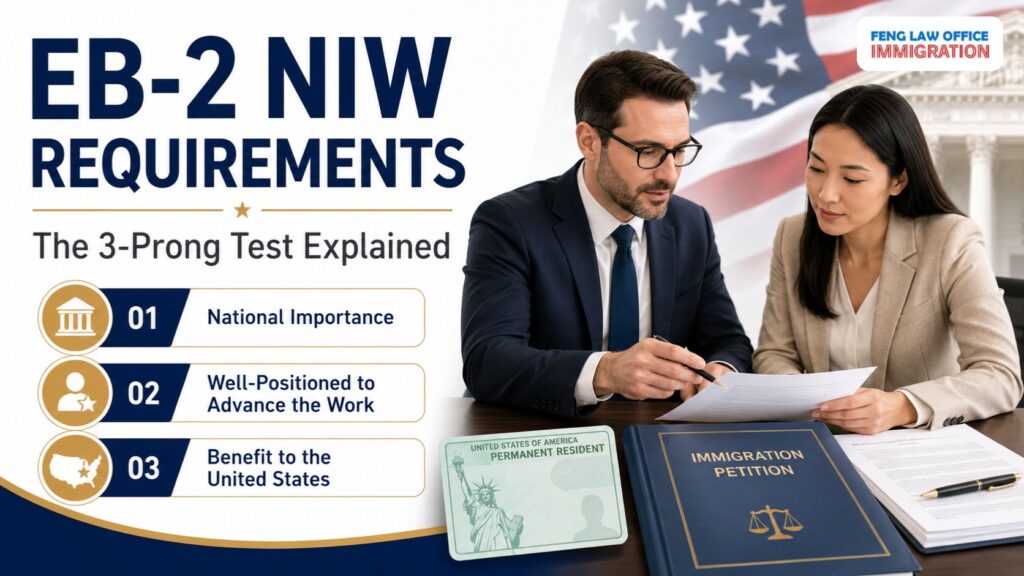
EB-2 NIW requirements are a two-step test: first, you must qualify for the EB-2 category as an advanced-degree professional or a person with exceptional ability; second, you must prove that your work meets the three-prong test for a national interest waiver. In plain English, USCIS wants to see that your work matters to the United States, that you are capable of advancing it, and that the country benefits from letting you apply without a job offer or labor certification.
That sounds simple. In real cases, it is not.
A strong EB-2 National Interest Waiver case is not just a stack of degrees, publications, recommendation letters, or business plans. It is a focused argument backed by evidence. The problem is that many applicants collect documents before they understand what USCIS is actually deciding.
What is the EB-2 National Interest Waiver?
The EB-2 National Interest Waiver is an employment-based immigrant petition that may allow qualified professionals to apply for permanent residence without a U.S. employer sponsor. USCIS states that people seeking a national interest waiver may self-petition and do not need an employer to sponsor them.
A regular EB-2 case usually needs a job offer and PERM labor certification. The NIW asks USCIS to waive those requirements because the applicant’s work serves the national interest.
This is why the case is not only about credentials. USCIS is not just asking, “Are you talented?” It is asking, “Why should the United States waive the normal employer-sponsored process for this person?”
In short: The national interest waiver is useful when your work has value beyond one employer and your evidence can show national-level benefit.
EB-2 NIW Requirements: the two layers you must satisfy
The first mistake applicants make is treating NIW as one single test. It is not.
You must pass two layers:
- EB-2 eligibility
- NIW eligibility under the three-prong test
Layer 1: EB-2 eligibility
To qualify for EB-2, you generally need to show one of the following:
- You are an advanced-degree professional
- You have exceptional ability in the sciences, arts, or business
“Advanced degree professional” usually means you have a U.S. master’s degree or higher, or a foreign equivalent. A bachelor’s degree plus at least five years of progressive experience may also qualify in many EB-2 cases.
Exceptional ability means expertise above what is normally found in your field. It is not the same as being generally good at your job. You need evidence such as education, years of experience, licenses, high compensation, professional memberships, or recognition.
Layer 2: NIW eligibility
After EB-2 eligibility, USCIS applies the Matter of Dhanasar framework. Under that framework, the applicant must prove three points:
- The proposed endeavor has substantial merit and national importance
- The applicant is well-positioned to advance the endeavor
- On balance, the United States benefits from waiving the job offer and labor certification requirements
USCIS confirmed in its January 2025 NIW guidance that a petitioner must first qualify under EB-2 before USCIS evaluates the national interest waiver request.
In short: Do not file an NIW case only because you have a strong resume. You need EB-2 eligibility plus a persuasive national interest argument.
What is the three-prong test for EB-2 NIW?
The three-prong test comes from the matter of Dhanasar, the decision USCIS uses to judge many NIW cases. The test focuses on the work you plan to do in the United States and your ability to move that work forward.
Here is the practical version:
Prong | What USCIS wants to know | Strong evidence usually shows |
Prong 1 | Does your proposed endeavor matter beyond personal career growth? | Public benefit, industry need, national priority, broad impact |
Prong 2 | Are you the right person to advance it? | Education, track record, results, expert support, progress already made |
Prong 3 | Should USCIS waive the job offer and PERM labor certification? | Work needs flexibility, urgency, independence, or benefit beyond one employer |
This table matters because it stops you from making the lazy argument: “I am qualified, so I should get approved.” That is not enough.
A better argument is, “My work addresses a real U.S. need, I have proof that I can advance it, and the usual employer-sponsored process would not serve the national interest as well.”
In short: The three-prong test is not a biography test. It is a national benefit test connected to your future work.
Prong 1: substantial merit and national importance
The first prong asks whether your proposed endeavor has substantial merit and national importance.
“Substantial merit” means the work has real value. It may involve science, technology, healthcare, business, education, infrastructure, energy, public safety, or another field with clear benefits.
“National importance” is where many cases get weak. USCIS is usually not impressed by work that only benefits one company, one local office, or the applicant’s own income. The case should show a broader impact.
Examples of stronger arguments may include:
- A researcher working on disease detection methods used by multiple institutions
- An engineer developing infrastructure safety systems
- A cybersecurity professional protecting small businesses or public agencies
- An entrepreneur building technology with job creation or industry impact
- A healthcare professional addressing shortage-area or public health needs
The key is not the job title. It is the scale and importance of the work.
Weak Prong 1 argument
“I am a software engineer, and software engineering is important.”
That is too broad. USCIS has seen that kind of claim a thousand times.
Stronger Prong 1 argument
“I develop security tools that help regional healthcare providers reduce ransomware exposure, protect patient data, and maintain service continuity. My work targets a documented national problem affecting healthcare systems across multiple states.”
That gives USCIS something to evaluate.
Expert tip: Do not describe your field. Describe the problem your work solves.
In short: For Prong 1, your proposed endeavor must be specific, useful, and connected to a U.S. need bigger than one employer.
Prong 2: well-positioned to advance the endeavor
The second prong asks whether you are well-positioned to advance the endeavor.
This is where your background matters. But again, USCIS is not just counting credentials. It wants proof that your past work supports your plan.
Useful evidence may include:
- Degrees, certifications, or licenses
- Published work or technical reports
- Patents or product development
- Grants, contracts, or funding
- Media coverage or industry recognition
- Recommendation letters from independent experts
- Prior results tied to your proposed work
- Business traction, users, customers, or partnerships
- A clear plan for your work in the United States
A common mistake is using generic recommendation letters. Letters that say “she is smart, hardworking, and respected” do not carry much weight. Letters should explain what you did, why it mattered, and how it supports your future proposed endeavor.
Weak Prong 2 evidence
A letter from your manager saying you performed your job duties well.
Stronger Prong 2 evidence
A letter from an independent expert explaining how your published method is used in the field, why it solves a real problem, and why your background makes you capable of expanding that work in the U.S.
In short: Prong 2 is about credibility. USCIS needs to see that your plan is not just a nice idea on paper.
Prong 3: Why waiving the job offer and labor certification benefits the U.S.
The third prong is often the hardest because it asks for balance.
USCIS considers whether it would benefit the United States to waive the normal job offer and labor certification process. USCIS may consider whether a job offer or labor certification would be practical, whether the U.S. would benefit from the work, whether the skillset is urgently needed, whether the endeavor may create jobs, and whether self-employment affects U.S. workers.
This prong is especially relevant for founders, researchers, consultants, inventors, and professionals whose work does not fit neatly into one sponsored job.
Weak Prong 3 argument
“I do not want to go through PERM because it takes too long.”
That is not a national interest argument. That is a personal convenience argument.
Strong prong 3 arguments may include the following:
- Your work requires collaboration with multiple hospitals and public health partners. A single employer-sponsored PERM process would restrict the very cross-institutional work needed to advance the project
- A single employer sponsorship would limit the national reach of your work
- The work addresses a time-sensitive U.S. need
- The endeavor may create jobs, tools, research, training, or public benefits.
- The labor certification process would not properly measure your unique role
In short: Prong 3 is not about avoiding paperwork. It is about showing why the waiver helps the United States.
EB-2 NIW vs. regular EB-2: What is the difference?
Many applicants confuse EB-2 and NIW. Here is the clean comparison.
Feature | Regular EB-2 | EB-2 National Interest Waiver |
Employer sponsor | Usually required | Not required in many cases |
Job offer | Usually required | Waived if NIW is approved |
PERM labor certification | Usually required | Waived if NIW is approved |
Main focus | Job-specific employer need | National benefit of the applicant’s work |
Who files | The employer usually files | An applicant may self-petition |
Best fit | Traditional sponsored employment | Researchers, founders, professionals with broader impact |
Main weakness | Employer and PERM dependency | Heavier evidence and legal argument burden |
Does EB-2 NIW require a job offer? Usually, no. That is one of the main reasons people pursue NIW. But no job offer does mean no work plan. You still need a clear plan for what you will do in the United States.
In short: NIW gives more independence, but it also demands a stronger explanation of national benefit.
What evidence is needed for EB-2 NIW?
There is no single magic document. Strong EB-2 NIW evidence usually works because the documents support one clear story.
Your evidence should answer five questions:
- What exactly will you do in the United States?
- Why does that work matter beyond your own career?
- What proof shows you can do it?
- Who outside your inner circle recognizes the value of your work?
- Why should USCIS waive the normal employer and labor certification process?
Practical evidence may include:
- Academic records and credential evaluations
- Employment verification letters
- Licenses, certifications, or memberships
- Publications, citations, patents, or technical work
- Independent expert letters
- Business plans, contracts, customer letters, or pilot results
- Government, industry, or institutional reports showing the need for your work
- Proof of funding, grants, awards, or partnerships
- Evidence of U.S. market need or public benefit
Do not dump everything into the petition and hope USCIS connects the dots. That is a bad strategy. Your petition should organize the evidence so the officer can see how each document supports the three-prong test.
Expert tip: If a document does not support EB-2 eligibility, Prong 1, Prong 2, or Prong 3, ask why it is being included.
In short: Good evidence is not about volume. It is about relevance, structure, and proof.
When EB-2 NIW may not be the right option
Honest answer: NIW is not for everyone.
You may need another immigration path if:
- Your work is mostly local with no broader impact
- Your evidence is too thin or too generic
- You cannot explain your future U.S. work clearly
- Your achievements are solid but not tied to national interest
- A regular employer-sponsored EB-2 case is simpler and stronger
- You may be a better fit for the O-1 extraordinary ability visa.
For example, if a company is ready to sponsor you and the job fits the PERM process well, a regular EB-2 route may be more practical. If you have a very high level of recognition, EB-1A may deserve a serious look. If you are not ready for an immigrant petition yet, an O-1 or other nonimmigrant option may be worth evaluating.
This is where a realistic case review matters. Filing a weak NIW petition can waste time, money, and momentum.
In short: NIW is powerful, but forcing a weak case into the NIW category is a bad move.
Final thoughts on EB-2 NIW requirements
The real test behind EB-2 NIW requirements is not whether your resume looks impressive. It is whether your evidence proves a clear national interest story: your work matters, you are positioned to advance it, and the United States benefits from waiving the regular job offer and labor certification process.
If your case has strong credentials but a vague plan, fix the plan before filing. If your work has national value but your evidence is scattered, organize it before filing. If you are unsure whether NIW, EB-1A, O-1, L-1, or another route makes more sense, get a case review before spending months on the wrong strategy.
Feng Law Office ׀ Immigration helps professionals, entrepreneurs, researchers, and families navigate U.S. immigration with clear legal guidance. To discuss your EB-2 National Interest Waiver options, call Feng Law Office.׀ Immigrate or schedule a consultation today.
Trust us and call us today.

Zechen Feng
Zechen Feng is the founder and principal attorney at Feng Immigration Law, where he is dedicated to helping individuals and families navigate the U.S. immigration system with clarity and confidence. With extensive experience in immigration law and a personalized approach to every case, Zechen is passionate about advocating for his clients’ rights and futures. Through the blog, he shares practical guidance, legal updates, and expert insights to empower those on their immigration journey.


 ICONIER Digital Agency